
What to do with all your kids' artwork
If your child draws every day, the paper arrives faster than you can find places to put it. You are not a bad parent for feeling a bit overwhelmed. Here is a calm way to sort it, keep what matters and let the rest go without guilt.
The short version
- Sort once a week or once a month, not whenever the pile gets scary.
- Keep a small number of favourites, and photograph the rest.
- Put today's best drawings where people actually look: the fridge, a string and pegs, a frame that opens.
- Write the date and your child's age on the back. Future you will be grateful.
- Use the leftovers: wrapping paper, cards, letters to grandparents.
Why the pile feels so hard
A drawing is not just paper. It is your child's afternoon, and often a story they told you while they made it. Throwing it away can feel like throwing that away too.
It helps to separate two things: the memory and the sheet of paper. You can keep the memory without keeping every sheet. Most of the ideas below are about doing exactly that.
Make one simple rule for what comes in
Pick one spot where new drawings land. A tray, a box, a clipboard on the wall. Everything goes there first. That alone stops drawings spreading across the kitchen table, the stairs and your handbag.
Once a week, or once a month if that is more realistic, go through the tray. Do it with your child if they are keen. Ask "which one is your favourite this week?" and let them choose. Children are often far less sentimental than adults, and they like being asked.
Decide what is worth keeping
You do not need a scientific method. A few questions are enough:
- Does it tell a story or show something your child said?
- Is it a new style, a first attempt at something, or a different way of drawing a person or an animal?
- Does your child love it?
- Would you be sad not to see it in ten years?
If the answer to all four is no, it is fine to let it go. Quick scribbles, the fifth identical rainbow of the day and colouring pages can usually be recycled. Do it when your child is not watching, or let them put it in the recycling bin themselves. Some children like that job.
Write on the back before you store anything
This takes ten seconds and makes a big difference. On the back of every keeper, write:
- The date, or at least the month and year.
- Your child's age.
- What they said it was, in their own words.
"Daddy as a dragon, he has three heads because he is very tall" is worth far more in ten years than the drawing alone. Use a soft pencil so it does not show through.
Photograph the ones you will not keep
A photo on your phone takes almost no space. Lay the drawing flat near a window, hold the phone directly above it, and take the picture in ordinary daylight. Try not to cast your own shadow across the page. You do not need a scanner.
Once you have the photo, the paper can go. A folder on your phone called "Drawings 2026" or "Drawings by age 5" is enough to start with. Back it up the way you back up your other photos.
Display the current favourites
Art that is on show gets enjoyed. Art in a box gets forgotten. A few low-effort ways to display it:
- The fridge. Magnets, a rotation of four or five pieces, and the old ones come down when new ones go up.
- String and pegs. A length of string across a wall or along a bookshelf, with small pegs. Easy to swap, and it looks deliberate.
- A frame that opens at the front. The drawing goes in and out in seconds. Children feel very proud of a framed picture.
- A cork board or a sheet of card. One board per child avoids arguments.
Keep the rule that something has to come down when something goes up. That way the display stays fresh and you are not making new decisions every week.
Give drawings a second job
Some drawings are better used than kept:
- Fold them into birthday cards or thank-you notes.
- Post one to a grandparent. Most grandparents will keep it for years and your pile gets smaller.
- Use large drawings as wrapping paper for small presents.
- Cut out a favourite shape and stick it to a card for a teacher at the end of term.
Children usually enjoy this more than keeping things in a box. Their work is going somewhere and doing something.
One box per child
For the real keepers, use one box per child. A flat archive box or a large portfolio folder is plenty. When it is full, something has to leave before something new goes in. It is a gentle limit that does the hard thinking for you.
At the end of each year, take out the best six to ten pieces and put the rest of that year into the recycling or the photo folder. If you do this every December, the whole job takes under an hour.
Where Doodlings fits
Doodlings is an iPhone and iPad app. It is a different way to keep a drawing, rather than a replacement for a box or a frame. You photograph a drawing, and the app lifts it off the page and sets it moving in a world. It is your child's own drawing that moves, with their colours and their wobbly line. Nothing is redrawn or generated by AI.
Because nothing expires, the worlds fill up over months. It can be a nice way to look back at what your child drew, and a reason to photograph a drawing before it goes in the recycling.
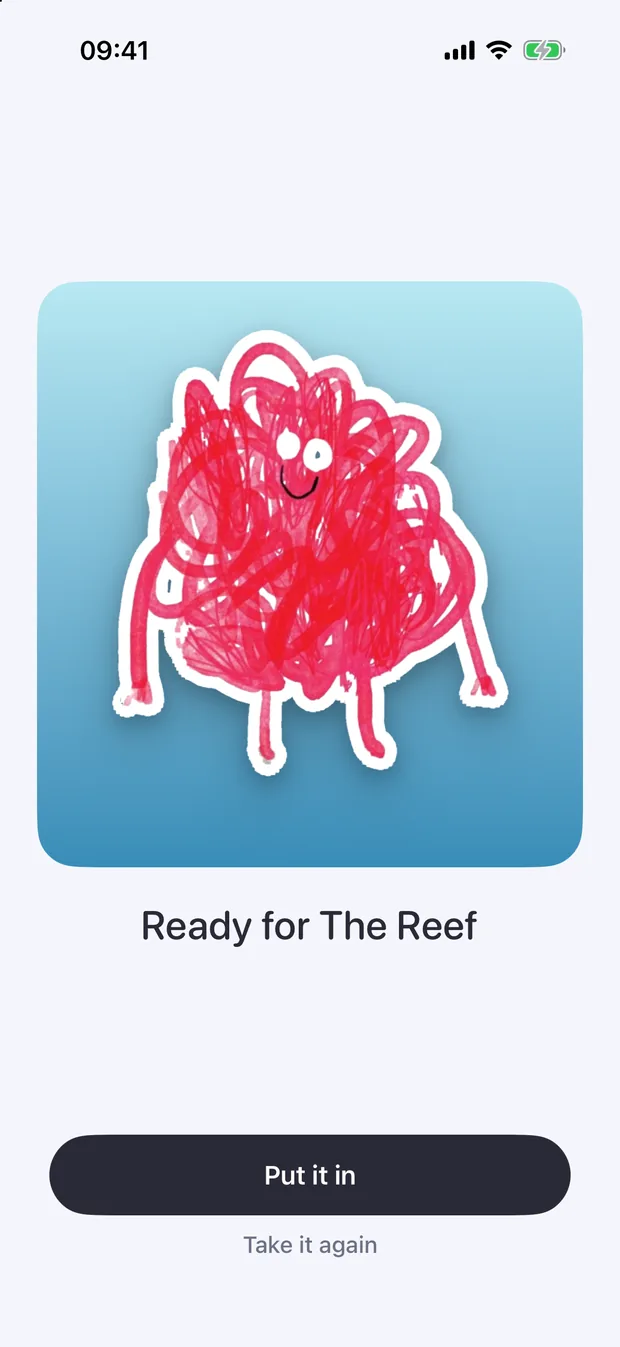
It works with any paper and any pen, including lined paper. There is no account and no sign-up, it works offline, and drawings stay on your device. The Reef and the first three drawings are free. Doodlings Plus opens the other three worlds and removes the drawing limit.